USI Post-Master's Certificate in Adult-Gerontology Acute Care NP: 28 credits and a full 750 hours
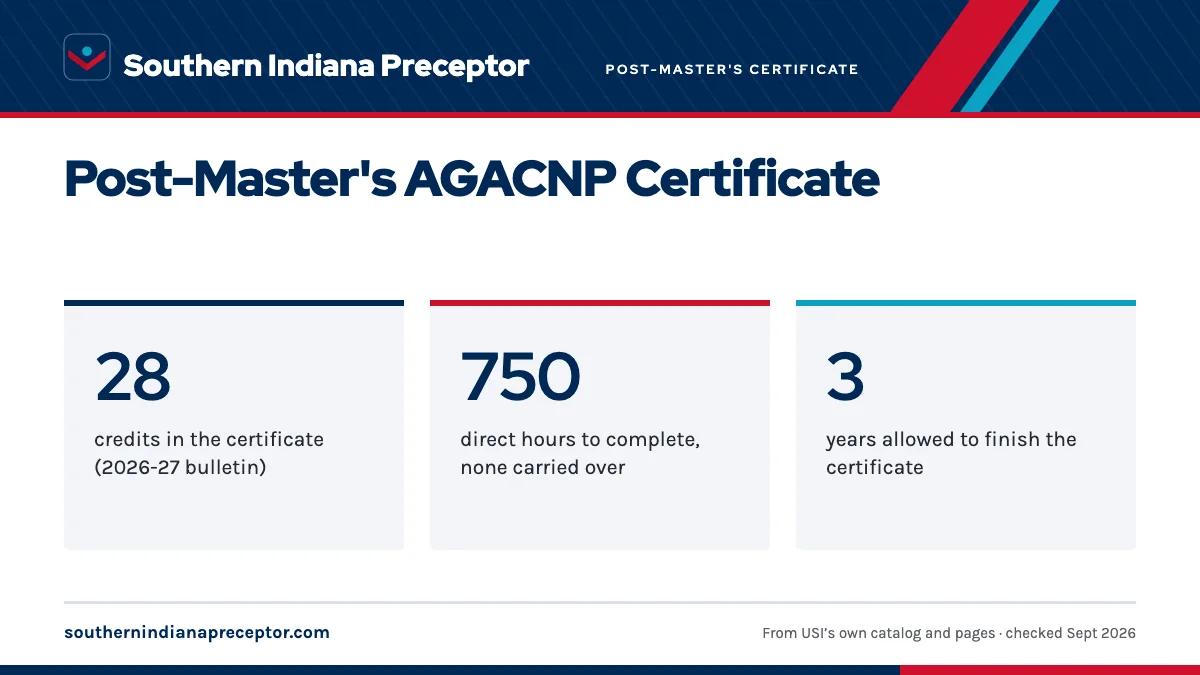
The University of Southern Indiana's Post-Master's AGACNP Certificate is a 28-credit online program for nurses who already hold an MSN. It runs the same four acute care courses as the MSN track, and USI credits no clinical hours from earlier study, so you complete all 750 direct hours in NRSG 633, NRSG 635 and NRSG 637. Admission is for May starts only.
Get your placement plan
Tell us your USI program and where you live. A placement advisor replies with the preceptor and site options that fit your course.
What the certificate contains
The 2026-27 Graduate Bulletin lists the certificate at 28 credit hours: a 9-credit PMC Clinical Core and the same 19-credit acute care specialty the MSN uses. USI's program page calls it 100% online. Because you already hold a master's, the MSN nursing core (NRSG 601 through NRSG 606) drops out.
USI's program-search tool still shows 24 credits, which was the total before the 2026-27 rebuild. Plan on 28, the figure printed in the bulletin and on the program page. The bulletin also carries the statement that USI's Post-Master's Certificate program is accredited by the Commission on Collegiate Nursing Education; the accreditation page explains what that covers.
| Block | Courses | Credits | Transfer |
|---|---|---|---|
| PMC Clinical Core | NRSG 621, NRSG 622, NRSG 623 | 9 | Considered after the gap analysis |
| Acute care specialty | NRSG 631 (2), NRSG 633 (6), NRSG 635 (6), NRSG 637 (5) | 19 | Must be completed at USI |
The gap analysis and the no-credit rule
USI completes a Gap Analysis for every applicant, and its Full Admission Requirements page states plainly that no clinical hours are credited toward the certificate. A family NP adding acute care, or a nurse with a non-clinical MSN, logs the same minimums as everyone else: 200, 250 and 300 direct hours across the three management courses.
The analysis matters most for the 3Ps. USI will look at graduate pathophysiology, pharmacology and advanced health assessment completed at an accredited school in the past five years, or older coursework if you can show current advanced clinical practice. For pharmacology, you also need active prescriptive authority where you practice today. The program page limits transfer to 9 graduate credits, and specialty APRN courses from other schools are not eligible.
What the gap analysis cannot shorten is the specialty. NRSG 631 through NRSG 637 are taken at USI, and every acute care clinical hour is earned there.
Timing from a May start
The certificate admits once a year, in May. The program page lists May 2027 (apply by April 2027) and then May 2028. Applicants submit three references with contact information on top of the core admission terms: a master's in nursing from a program with both national and regional accreditation, at least a 3.00 GPA, and an RN license without encumbrance.
USI publishes no sample plan for the certificate, but its course listings fix the clinical rhythm: NRSG 631 in Summer, followed by Management I, II and III across the next Fall, Spring and Summer. NRSG 631 requires NRSG 622 and runs alongside NRSG 623, so the number of 3Ps your gap analysis leaves you decides whether your first acute care Fall comes a few months after you start or more than a year later.
Certificate students must finish within three years under USI's progression policies. Because each management course runs in one term a year, a missed clinical semester costs a full year, which makes preceptor planning part of staying inside that limit.
Preceptors when you already practice
If you already work in health care, your network is a head start: colleagues, former preceptors, physicians you round with. USI's rules still apply in full. The preceptor must be an NP, PA, MD or DO in acute care, and an NP or PA preceptor has to hold board certification matching your new track, which here means acute care rather than family or primary care.
Precepting at your own workplace is not addressed directly. USI asks struggling students whether their employer offers a preceptor, which implies employer sites can work, but a rotation may not be used as workplace orientation, and USI's malpractice policy protects you only while you are functioning as a student. A relative or partner cannot precept you. Clinicals at your workplace goes further.
USI's certificate page says the online program works with preceptors in numerous states. The Graduate Nursing Handbook still places identifying preceptors with the student, and the Graduate Clinical Liaison approves each one before any hours count.
Which states the certificate accepts
The certificate has its own row in USI's Professional Licensure Disclosure, and it is not a copy of the MSN row. Residents of the states in the table below, plus DC and several territories, may not enroll. Compared with the MSN NP list, Arizona and Mississippi drop off while Colorado, South Dakota and Washington join.
The same row marks Colorado, Louisiana, Massachusetts and Mississippi as not meeting licensure requirements, so a Mississippi resident who is allowed to enroll still faces a licensure question. Read the whole row on the licensure disclosure page and confirm with USI before you apply.
Wherever you live, each state that hosts your clinical hours must also have issued you an unencumbered RN license, a rule that binds certificate students exactly as it binds MSN students.
| Region | States and jurisdictions |
|---|---|
| South | Alabama, Delaware, Louisiana, Oklahoma |
| Northeast | Massachusetts, New York, Pennsylvania |
| Midwest and Plains | Minnesota, North Dakota, South Dakota |
| West | Colorado, Nevada, Oregon, Washington, Wyoming |
| Also listed | District of Columbia, American Samoa, Guam, Northern Mariana Islands, Puerto Rico |
Clearance before your first acute care shift
Certificate students go through the same compliance steps as MSN students, recorded with DISA (formerly CastleBranch), USI's designated third-party agency.
- Current ACLS, required for every AGACNP student, plus BLS.
- Criminal background screening at the national level and a drug screen of at least 10 panels, submitted before you begin graduate nursing coursework, then a yearly Zachary's Law registry check.
- Immunizations and TB screening under the Kinney College Infection Control Policy, with nothing allowed to expire before the semester ends.
- Annual HIPAA and OSHA training; certificates from your employer are accepted.
- Health insurance, a clinical name badge and your own transportation to clinical sites.
Due dates and what happens when an item is late are on the DISA compliance page.
Why certificate students choose us
You already know how clinical rotations work. What you need is the right acute care preceptors, lined up in the right order, while you keep working. Your placement advisor finds NPs, PAs and physicians in acute care near your home, screens them against USI's rules, including acute care board certification for NP and PA preceptors, and plans NRSG 633, NRSG 635 and NRSG 637 as one sequence, with the critical care or hospitalist setting USI prefers for the last course.
We assemble every field Form G and the agreement request require, then time each packet around both the hospital's own student process and USI's 6-week window, so your paperwork arrives complete and early. Should a preceptor leave, we source the replacement while you keep working. USI signs off on every preceptor and site, and our packets are built to spare you the back-and-forth. Start here or use the form below.
Questions USI students ask
I am already a board-certified FNP. Do any of my clinical hours count?
No. USI completes a gap analysis for every certificate applicant, and its admission rules say no clinical hours are credited for the Post-MSN APRN Certificate. You will log at least 750 direct acute care hours in NRSG 633, NRSG 635 and NRSG 637. Your earlier coursework may still reduce the 3Ps if it meets USI's transfer conditions.
Can I start the AGACNP certificate in January or August?
USI's certificate pages list May starts only, with applications due in April: May 2027, then May 2028. The MSN AGACNP track admits in January, May and August, but the certificate does not follow that pattern. Miss the April deadline and your next certificate entry point is the following May.
How is the certificate different from the MSN AGACNP?
The specialty is identical: the same four acute care courses and the same 750 direct hours. The certificate drops the 16-credit MSN nursing core because you already hold a master's, which brings it to 28 credits instead of 44. It also has its own licensure-disclosure row, a May-only start and a three-year completion limit. See the MSN AGACNP page.
Do I need ACLS for the AGACNP certificate?
Yes. USI requires every student in the AGACNP program to hold current Advanced Cardiac Life Support, and certificate students take the same acute care courses. Keep it current in DISA alongside BLS, with nothing expiring during a semester; renewing well before NRSG 633 begins avoids a gap later in the sequence.
How long do I have to finish the certificate?
Three years. USI's graduate progression policies require Post-MSN APRN Certificate students to complete their requirements within that time. Since each acute care course runs once a year and the clinical run takes three consecutive semesters, a single lost semester uses up a year of that allowance, so line up preceptors well ahead of each term.
Related pages
Last checked 2026-09-25
We check these pages against USI's own bulletin, program pages and Graduate Nursing Handbook. Your handbook, course faculty and the Nursing Clinical Coordinator have the final word.
- University of Southern Indiana 2026-2027 Graduate Bulletin: Post-Master's Certificate, Adult-Gerontology Acute Care Nurse Practitioner
- University of Southern Indiana: Post-Master's Certificate in Adult-Gerontology Acute Care Nurse Practitioner
- University of Southern Indiana Graduate Nursing Handbook: Full Admission Requirements
- University of Southern Indiana Professional Licensure Disclosure
- University of Southern Indiana Graduate Nursing Handbook: Course Requirements
USI makes the search your job. We make it the easy part.
Tell us your USI track, your city and your next clinical semester. We find preceptors who fit the NRSG course and fill the Preceptor Packet and Clinical Education Agreement request with typed, complete details, well before USI's 6-week window.
- Preceptors matched to the course: family primary care for FNP, acute care teams for AGACNP, PMHNPs and psychiatrists for PMHNP
- Preceptor license, certification, years of practice and the site's agreement signer ready for the packet
- Fall, Spring and Summer planned together, close to home in a state USI enrolls
Start your placement plan
Track, city and clinical start is all we need to begin.