USI online RN-to-BSN: practice experiences, preceptors and the sites you choose
The University of Southern Indiana's online RN-to-BSN places its hands-on work in three 4-credit courses, NURS 457, NURS 487 and NURS 492, and expects you to identify practice sites that meet each course's needs where you live. Your preceptor is a registered nurse with at least six months in the area you pick, faculty approve the preceptor and site before any hours begin, and USI publishes no hour count for the three courses, so your course faculty set it.
Plan your RN-to-BSN practice sites
Tell us your state and which of NURS 457, 487 or 492 comes next.
How the degree is built
The RN-to-BSN is a Kinney College of Nursing and Health Professions degree completion program with didactic courses 100% online. The 2026-27 Undergraduate Bulletin sets 120 credits for the BSN, including 30 nursing credits that each need a C or better and 18 to 19 credits of supporting courses. USI's web page says you can finish in as little as 14 months.
Starts come often: October 19, 2026, then January 11, March 15, May 10 and June 28, 2027. Admission asks for an associate degree in nursing from a program with regional and national nursing accreditation, a 2.3 GPA (2.0 to 2.29 considered case by case), an unencumbered RN license, and one condition that matters for placements: you must be "employed by or have access to a healthcare work environment to complete course projects."
| Course | Title | Credits | Terms | Practice component |
|---|---|---|---|---|
NURS 307 | Health Assessment for Registered Nurses | 3 | Fall, Spring, Summer | None listed |
NURS 327 | Transition to Advanced Nursing Practice | 3 | Fall, Spring, Summer | None listed |
NURS 331 | Care Coordination in Professional Nursing Practice | 3 | Fall, Spring, Summer | None listed |
NURS 333 | Nursing Informatics | 3 | Fall, Spring, Summer | None listed |
NURS 337 | Population Health and Professional Nursing Practice | 3 | Fall, Spring, Summer | None listed |
NURS 367 | Application of Evidence Based Practice | 3 | Fall, Spring, Summer | None listed |
NURS 457 | Population-Focused Care for Registered Nurses | 4 | Fall, Spring | Community assessment |
NURS 487 | Leadership in Nursing and Healthcare Organizations | 4 | Spring, Summer | 3-1 (Clinical) |
NURS 492 | Clinical Synthesis for RNs | 4 | Fall, Summer | Concentrated clinical experience |
What each practice course asks of you
The RN-to-BSN handbook says the practice experiences in these three courses let you apply course content in varied settings, with both direct and indirect care. Each course points that work in a different direction.
NURS 457 Population-Focused Care has registered nurses build on their earlier clinical experience with a focus on community assessment, which points toward a community agency, a public health office or another population-level setting. NURS 487 Leadership in Nursing and Healthcare Organizations, listed as "3-1 (Clinical)," integrates the nurse manager and leader role within the clinical experience. NURS 492 Clinical Synthesis for RNs is described as "a concentrated clinical experience designed to expand and synthesize nursing knowledge and evidence-based practice."
The term offerings shape your order. NURS 457 runs in Fall and Spring, NURS 487 in Spring and Summer, and NURS 492 in Fall and Summer, so check which of the three your next session holds before you start contacting sites. A 2025 version of USI's RN-to-BSN handbook page also described a community partner, the main contact at an agency who helps plan, carry out and give feedback on a Service-Learning Project.
Hours: set by your course, not published
No USI page, handbook or bulletin entry states the number of practice hours in NURS 457, NURS 487 or NURS 492. The campus BSN's rule of three clinical hours per credit is written for that program, so do not assume it carries over. Your syllabus and course faculty set the expectation for each course, and it is worth asking for it in writing before you commit a preceptor's time.
What USI does state is the consequence. The RN to BSN progression policy says a student "must satisfactorily complete all course practice requirements including direct and indirect care activities," and anyone who does not receives an F in the course. Strong papers cannot rescue a missing practice requirement.
Scheduling is tight because the courses are short. The web page advertises eight-week classes, while USI's accelerated calendar runs its online OL and DL sessions over seven weeks. Either way, a practice experience that starts late has very little room to recover, so line up your site before the session opens. The semester calendar page lists the session dates.
An unfinished practice requirement means an F in the course, no matter how strong the written work is.
Who can precept an RN-to-BSN student
The BSN Undergraduate Student Handbook's Preceptor Guidelines and Forms page, which covers the RN-to-BSN, describes the preceptor as a registered nurse licensed in the state of practice with six months of experience in the selected clinical practice area. Its selection criteria add a current unencumbered RN license, at least six months of RN work, competence as defined by the preceptor's employer, and approval from the nurse manager or chair of the area.
Faculty must approve the preceptor and the site before you begin clinical hours. USI's roles document for BSN completion students says faculty arrange experiences in collaboration with the preceptor, and that you give the preceptor, the agency and faculty proof of liability insurance, OSHA and HIPAA completion, your nursing license for the state where the experience happens, your immunization status and CPR certification.
Older USI documents set a higher bar. A 2021 guideline and the 2022 undergraduate preceptor agreements asked for 18 months of experience, and the 2024 agreement says 18 months in its header while its checkbox asks about six. The current handbook says six months; if your preceptor falls between six and 18, confirm with course faculty first.
Setting up a practice experience where you live
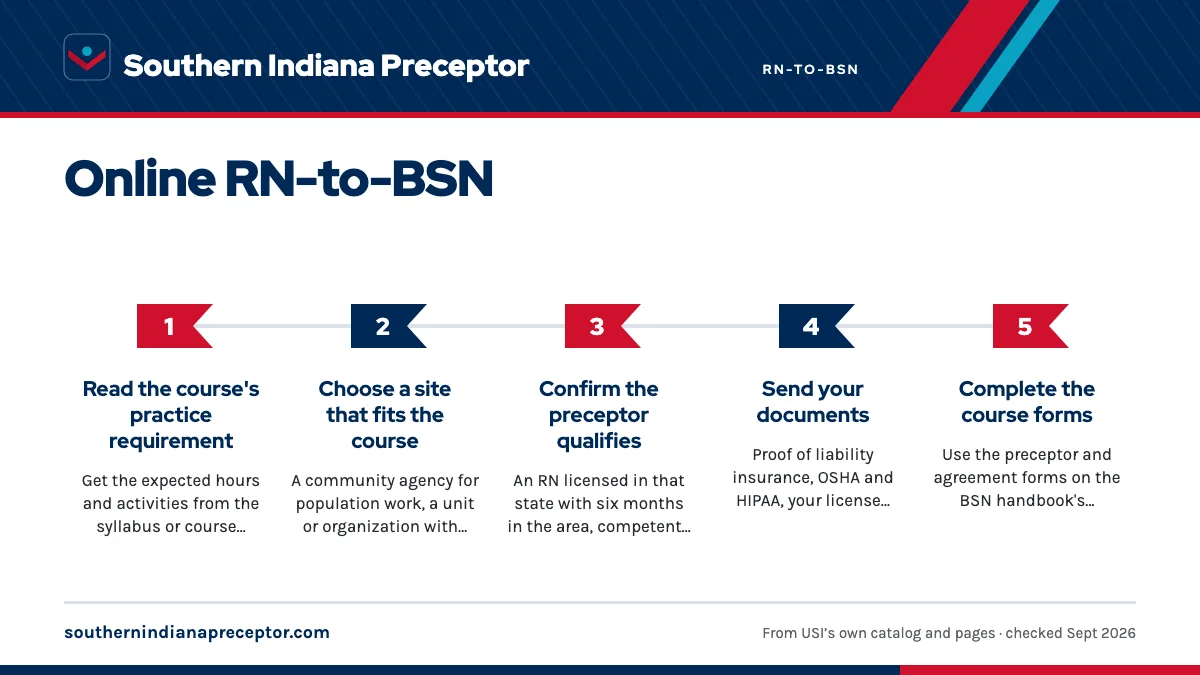
- Read the course's practice requirementGet the expected hours and activities from the syllabus or course faculty before anything else.
- Choose a site that fits the courseA community agency for population work, a unit or organization with active nurse leaders for leadership, a clinical setting for the synthesis course.
- Confirm the preceptor qualifiesAn RN licensed in that state with six months in the area, competent by their employer's standard and approved by their nurse manager or chair.
- Send your documentsProof of liability insurance, OSHA and HIPAA, your license, immunizations and CPR go to the preceptor, the agency and faculty.
- Complete the course formsUse the preceptor and agreement forms on the BSN handbook's Preceptor Guidelines and Forms page, as course faculty direct.
- Wait for faculty approvalApproval of the preceptor and site comes before your first practice hour.
Personal travel is expected for all practice experiences. Your RN license must cover the state where the site sits, which matters in the tri-state: Illinois is not a Nurse Licensure Compact state, so a multistate license from Indiana or Kentucky does not reach an Illinois site, and Kentucky has its own preceptor licensing expectations explained on clinicals in Kentucky.
Where you can enroll
The RN-to-BSN leads to no new license, so USI's Professional Licensure Disclosure marks it "No License," but the program still has an "Enrollment Not Allowed" list: Alabama, Colorado, Louisiana, Minnesota, Mississippi, Nevada, New York, Oklahoma and Wyoming, plus DC, American Samoa, Guam, the Northern Mariana Islands and Puerto Rico. The licensure disclosure page shows every program's row.
USI also runs an ASN to BSN (A2B) dual enrollment path, which lets you earn BSN credits while finishing an associate degree at partner colleges such as Henderson Community College, Madisonville Community College, Ivy Tech Community College, Rend Lake College, Southeastern Illinois College and Illinois Eastern Community Colleges. A2B students follow the same course list, and an unencumbered RN license is required before enrolling in the 400-level practice courses.
Why RN-to-BSN students choose us
It is tempting to assume your own unit can host all three practice courses, but each course points to a different kind of setting. We match you with sites near home that fit each focus: a community partner for population work, nurse leaders for NURS 487 and a clinical setting for the synthesis course.
We confirm every preceptor meets USI's current standard, a licensed RN with six months in the area and their manager's approval, and we assemble the documents faculty and the agency expect, so approval moves quickly inside a short session.
If a site changes its mind or a preceptor leaves partway through, your placement advisor finds a new one fast, which matters when a session lasts only seven or eight weeks. See how it works or tell us your state and next course with the form below.
Questions USI students ask
Can I do my RN-to-BSN practice experiences at the hospital where I work?
USI expects you to be employed in or have access to a healthcare work environment, and the handbook asks you to identify sites within your location, so your employer is a natural place to start. Each course still needs the right kind of setting and an approved preceptor, and population-focused work may point you outside your own unit. Check each choice with course faculty.
Do I ever have to come to the Evansville campus?
USI describes the RN-to-BSN coursework as 100% online, and its program page quotes a graduate who never needed to visit campus. Your practice experiences happen at sites in your own area, and personal travel to those sites is expected. Nothing in the program's published requirements schedules an on-campus session.
What is the difference between the RN-to-BSN and the A2B path?
A2B is dual enrollment: you take USI's RN-to-BSN courses while still completing an associate degree at a partner college, and move into the 400-level practice courses once you hold an RN license. It is not a separate program in the bulletin. The practice courses, NURS 457, NURS 487 and NURS 492, require an unencumbered RN license before you enroll.
Are USI RN-to-BSN courses seven or eight weeks long?
USI's own pages disagree. The program page advertises eight-week classes, while the accelerated calendar and refund schedules use seven-week OL and DL sessions. Go by the dates on your schedule in myUSI, and plan practice hours on the shorter window so you are never caught at the end of a session.
What happens if a practice site dismisses me?
The RN-to-BSN handbook says a student dismissed from a practice site must identify and complete an alternate activity that meets the course requirements. Tell course faculty immediately, agree on the alternative with them, and keep in mind that an unfinished practice requirement leads to an F in the course.
Related pages
Last checked 2026-09-25
We check these pages against USI's own bulletin, program pages and Graduate Nursing Handbook. Your handbook, course faculty and the Nursing Clinical Coordinator have the final word.
- University of Southern Indiana 2026-2027 Undergraduate Bulletin: Nursing Major, B.S.N. (RN to BSN)
- University of Southern Indiana: RN to BSN program page
- University of Southern Indiana BSN Undergraduate Student Handbook: Preceptor Guidelines and Forms
- University of Southern Indiana RN-BSN Nursing Student Handbook 2022-2023
- University of Southern Indiana: RN to BSN Progression Policies
USI makes the search your job. We make it the easy part.
Tell us your USI track, your city and your next clinical semester. We find preceptors who fit the NRSG course and fill the Preceptor Packet and Clinical Education Agreement request with typed, complete details, well before USI's 6-week window.
- Preceptors matched to the course: family primary care for FNP, acute care teams for AGACNP, PMHNPs and psychiatrists for PMHNP
- Preceptor license, certification, years of practice and the site's agreement signer ready for the packet
- Fall, Spring and Summer planned together, close to home in a state USI enrolls
Start your placement plan
Track, city and clinical start is all we need to begin.