California residents in USI's online NP programs
Every online nursing program at the University of Southern Indiana admits California residents, and USI's table rates each NP track as meeting California's requirements. The catch is clinical: California's Board of Registered Nursing must approve a nurse practitioner program from another state before its students train there, so settle USI's standing before you sign a preceptor.
Get your placement plan
Tell us your USI program and where you live. A placement advisor replies with the preceptor and site options that fit your course.
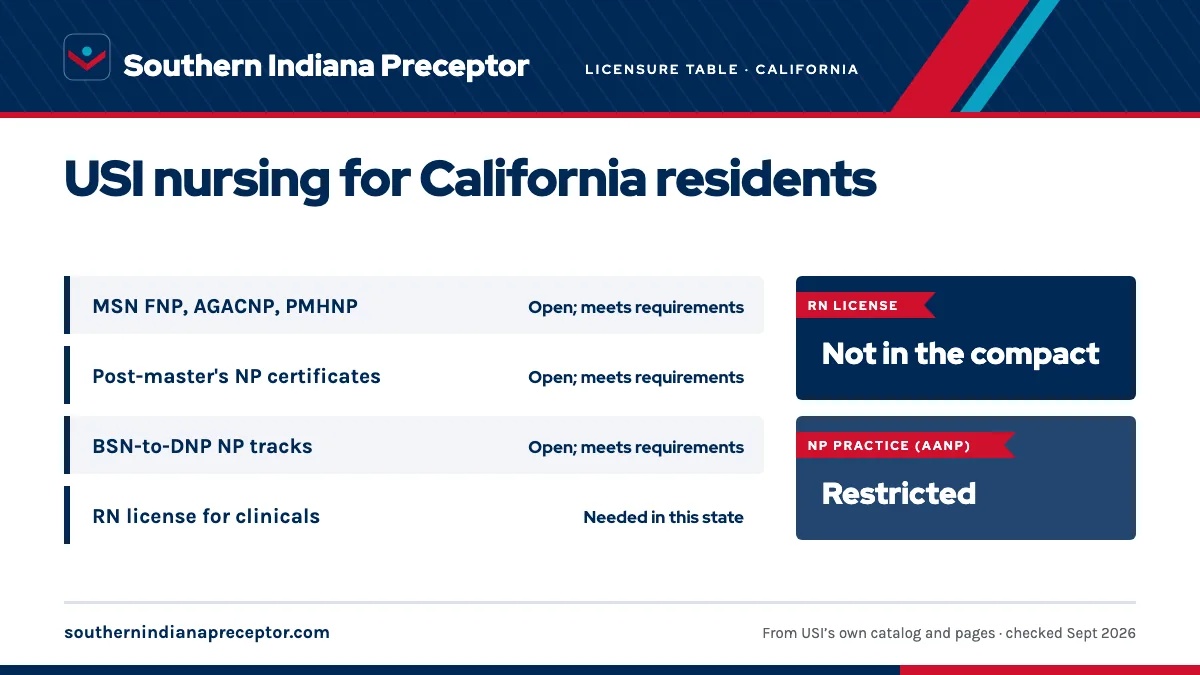
USI's California row
In USI's Professional Licensure Disclosure ("Updated Fall 2025"), California reads "meets" for every NP program and is absent from each Enrollment Not Allowed cell. That settles admission only. Whether your hours can happen in California turns on the Board rule below, not on this table.
| Program group | USI's answer for California | Enrollment for residents |
|---|---|---|
| MSN FNP, AGACNP, PMHNP | Meets | Allowed |
| Post-master's certificates, all three | Meets | Allowed |
| BSN-to-DNP FNP, AGACNP, PMHNP; post-MSN DNP | Meets | Allowed |
| Leadership MSNs, BSN-to-DNP OSL, RN-to-BSN | No license involved | Allowed |
The BRN's rule for NP programs based elsewhere
California's regulation 16 CCR § 1486 bars an NP program located outside California from placing students in California clinical settings until the Board of Registered Nursing has approved it. Approval also commits the program to NONPF and AACN standards, to preceptors who satisfy Board requirements, and to teaching California NP law: the standardized procedure rules and sections 2835.7 and 2836.1 of the Business and Professions Code.
Everything here runs through the school. The school opens the file by sending the BRN its Verification of Clinical Practice Experience, which goes to a scheduled Board meeting for a decision, and afterward the school keeps a separate NP Program Preceptor form on every preceptor it uses in California. The BRN's list of categories covers Family, Adult-Gerontology Acute and Psychiatric/Mental Health. Our research does not show whether USI has this approval, so put that question to the Nursing Clinical Coordinator before you contact a single practice.
What section 1486 expects of each preceptor
- California licensure, active and valid, in whatever profession the preceptor practices
- Qualification in the NP category you are studying
- An orientation from USI, with faculty re-evaluating them at least every second year
- A written agreement among agency, preceptor and program that defines the preceptor's role
USI's standards sit on top: specialty certification, at least twelve months of advanced practice, and track limits such as PMHNP-or-psychiatrist for PMHNP students (USI's preceptor rules).
Restricted practice, and where California NPs work
AANP files California under restricted practice: certain settings and procedures require an NP to keep a standardized protocol agreement, though the Board allows exemptions. Your preceptor's practice may well run on those standardized procedures, the very material section 1486 wants an outside program to teach.
Greater Los Angeles (the Los Angeles-Long Beach-Anaheim metro, about 12.8 million people) dwarfs the rest; the Inland Empire's Riverside-San Bernardino-Ontario metro, the Bay Area's San Francisco-Oakland-Fremont metro and San Diego's metro follow. Oakland-based Kaiser Permanente splits the state into Northern and Southern regions, and Sutter Health covers Northern and Central California. Six academic medical systems sit under University of California Health, from UCSF and UC Davis in the north to UCLA, UCI, UCR and UC San Diego in the south. Add Stanford Health Care and the Los Angeles hospital Cedars-Sinai for the other big names. None of them appears here as a site committed to USI students.
Licensing: California RN, and no compact
Section 1486(d) spells it out: a student in an out-of-state NP program needs an active California RN license for any California clinical experience, which lines up with USI's own license rule. California never joined the Nurse Licensure Compact, so nothing substitutes. The state's student exemption, Business and Professions Code 2729, speaks of board-approved programs and courses, one more reason to settle approval first. After graduation, California NP certification also builds on that RN license. Telehealth hours in FNP and PMHNP courses follow the patient's state (RN license guide).
How we work for California students
California rewards preparation. We start by pinning down the approval answer with you, then search for preceptors who clear both USI's bar and the BRN's, complete Form G and the agreement request with every license number and signer USI will look for, and file it typed and complete well ahead of USI's deadlines. Across Fall, Spring and Summer, a backup plan stays ready in case a preceptor steps away. Send us your track and county.
Questions USI students ask
Does USI hold California BRN approval for NP clinical placements?
The research behind this page does not record USI's status. The BRN posts its out-of-state NP program information on its education pages, and the Nursing Clinical Coordinator (usi1nursing@usi.edu) can tell you whether USI can place students in California. Ask before recruiting a preceptor, because the regulation holds placements until the program is approved.
Can a physician assistant precept my USI FNP hours in California?
USI accepts PAs in FNP and AGACNP courses and never in PMHNP. California adds its own test: the preceptor must be licensed in California in their field and suited to the NP population you are training for. How USI and the BRN apply that to a PA is a question for the Nursing Clinical Coordinator. See the PA preceptor guide.
How does California's written-agreement rule fit USI's paperwork?
California wants an agreement among agency, preceptor and program that defines the preceptor's role. On USI's side, the site signs the Clinical Education Agreement (students may not sign it), and the preceptor signs the Preceptor Agreement inside Form G. Ask whether USI adds anything for California; the Clinical Education Agreement guide explains USI's version.
What if I relocate to California mid-program?
Your enrollment survives the move, since California is open to every USI nursing program. Before packing, write to the Program Chair and APRN Director, apply for a California RN license, and resolve the BRN approval question before the next rotation begins. The relocation guide walks through the order of steps.
Related pages
Last checked 2026-09-25
We check these pages against USI's own bulletin, program pages and Graduate Nursing Handbook. Your handbook, course faculty and the Nursing Clinical Coordinator have the final word.
USI makes the search your job. We make it the easy part.
Tell us your USI track, your city and your next clinical semester. We find preceptors who fit the NRSG course and fill the Preceptor Packet and Clinical Education Agreement request with typed, complete details, well before USI's 6-week window.
- Preceptors matched to the course: family primary care for FNP, acute care teams for AGACNP, PMHNPs and psychiatrists for PMHNP
- Preceptor license, certification, years of practice and the site's agreement signer ready for the packet
- Fall, Spring and Summer planned together, close to home in a state USI enrolls
Start your placement plan
Track, city and clinical start is all we need to begin.