How Indiana's NP rules shape who can precept you
Indiana writes collaboration into every nurse practitioner's practice but asks for a signed practice agreement only from NPs who prescribe. For a University of Southern Indiana student, an Indiana NP preceptor who prescribes brings a collaborating practitioner, a chart-review routine and two controlled substance registrations into the rotation, and each one shapes what you can do in clinic.
Get your placement plan
Tell us your USI program and where you live. A placement advisor replies with the preceptor and site options that fit your course.
Two Indiana rules that are easy to confuse
The statute and the board's rule answer different questions. The statute, IC 25-23-1-19.4(c), governs how an APRN practices at all: through collaboration with a licensed practitioner, documented in a practice agreement, or under privileges a hospital's governing board grants. The rule, 848 IAC 5-2-1, governs the paperwork, and it makes a written practice agreement necessary only when the nurse seeks prescriptive authority.
IPLA's licensing page ties the two together. The Indiana APRN license, it says, is the authority to prescribe rather than a license to practice as a nurse practitioner, and an APRN who has no need to prescribe practices on an Indiana RN license or a compact RN license. The collaboration section has stood since a 2020 amendment, with no change from 2023 through 2026 and no transition-to-practice rule.
An Indiana NP who prescribes therefore has a signed agreement, a named collaborator and a reviewed prescribing record, and knowing that helps you answer a careful preceptor's questions before they sign USI's Preceptor Packet.
What an Indiana prescribing agreement contains
The board's prescribing rule, 848 IAC 5-1-1, readopted in July 2024, lists what the APRN and the collaborating practitioner must write down:
- Names and addresses of both, and every location where the APRN prescribes
- The APRN's certifications
- How the two work together, keep geographic proximity and cover for each other
- Any limits placed on the APRN's prescribing
- The review process, any other agreements the APRN holds, and the agreement's duration
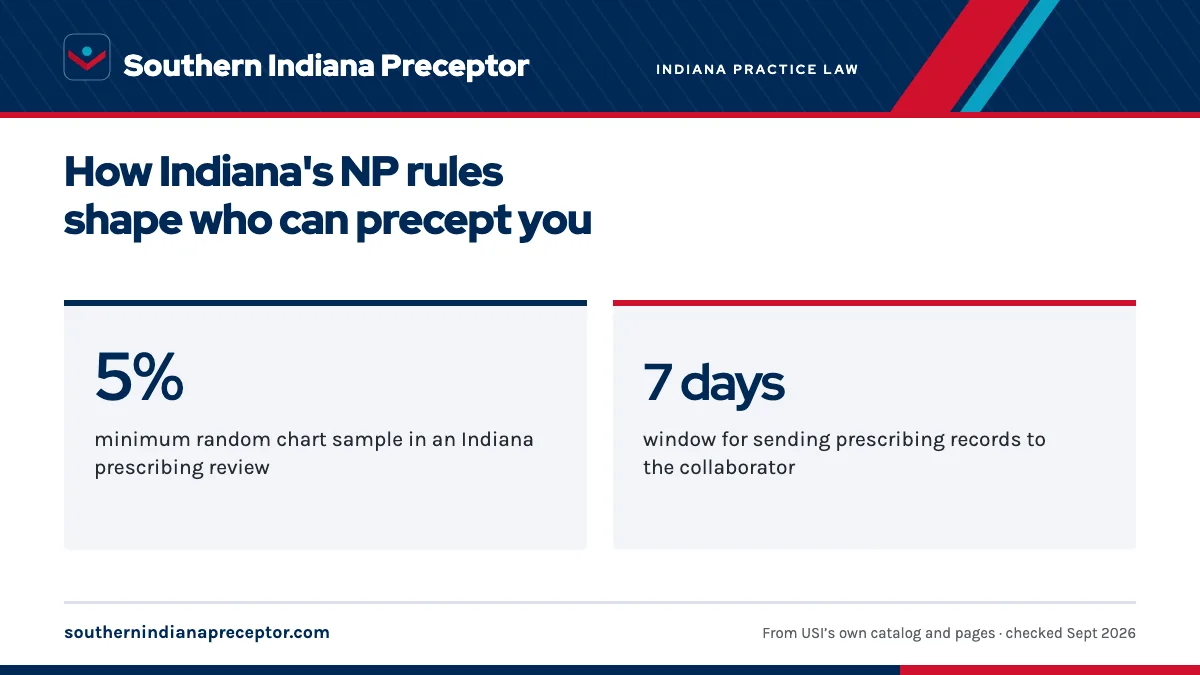
The review has a floor. The APRN sends the collaborating practitioner documentation of their prescribing within seven days, covering at least a 5% random sample of charts and the medications prescribed. IPLA must also randomly audit between 1% and 10% of practice agreements under IC 25-23-1-19.8.
Controlled substances add two registrations: an Indiana controlled substance registration (CSR) and a federal DEA registration. IPLA's CSR page requires an Indiana practice address that matches the address on the DEA registration. Renewing prescriptive authority takes 30 continuing education hours, 8 of them in pharmacology, and a current signed agreement.
How those rules reach your rotation
Any prescription from a visit you help with goes out under your preceptor's authority, so your assessments and plans feed charts their collaborator may pull for review. Write every note as though it could be sampled, and log the encounter in Typhon the way your course faculty expect.
Location matters too. Because the agreement names each place the APRN prescribes, a preceptor who offers to host you at a second clinic or a newly opened office should confirm that site is on their agreement before you enter it on Form G. The same logic applies to the DEA number Form G's preceptor section requests: in Indiana it sits beside a CSR tied to an Indiana practice address, so a preceptor who has just moved practices may have registrations to update.
Prescriptive authority also rests on a current signed agreement, so a preceptor between collaborators cannot prescribe until a new one is in place. Ask about the agreement's status at your first meeting.
Who can precept you in Indiana under USI's rules
USI's standard is the test your preceptor has to pass, wherever they practice: an unencumbered license, certification in their specialty, at least one year as an advanced practice provider and a signed agreement with USI, with relatives and partners excluded. By track, FNP students may train with FNPs, PAs and primary care physicians, AGACNP students with NPs, PAs, MDs or DOs in acute care, and PMHNP students only with a PMHNP or a licensed psychiatrist; see physician assistant preceptors for the PA rule.
Indiana's statute gives acute care a second route. An APRN may operate under privileges granted by a hospital's governing board, a route that fits hospital-based AGACNP preceptors, and in that case the hospital's student application, with its own deadlines, is the gate to plan around rather than a clinic's practice agreement.
Indiana's code also says each clinical preceptor must be a nurse licensed under the nursing article. USI, an Indiana program, still lists physicians and PAs for its FNP and AGACNP tracks, and the board does not review graduate programs; if a site raises the clause, the Graduate Chair and APRN Director can answer for the program.
Your own Indiana prescriptive authority after graduation
The same rules will apply to you once you finish. Indiana's statute asks for a graduate-level pharmacology course of at least two semester hours, and USI's NRSG 622 Advanced Clinical Pharmacology for the APRN is a three-credit Spring course taken before the specialty sequence.
The board's rule adds a clock: the pharmacology course should fall within five years of your application. If it is older, you need 30 continuing education contact hours in the last two years, 8 of them in pharmacology, plus prescriptive experience. Graduates who plan to prescribe in Indiana should apply for prescriptive authority, a CSR and a DEA registration with that window in mind, and line up a collaborating practitioner before the first prescription.
Why students choose us for Indiana preceptors
We ask Indiana preceptors the questions their rules raise before your packet is drafted: whether they hold prescriptive authority, which locations their agreement covers, their DEA and CSR details, and for acute care whether they practice on hospital privileges. That lets us propose preceptors who fit USI's standard for your track and sites where the paperwork lines up, then send USI a typed, complete Form G with the agreement signer named. We plan Fall, Spring and Summer as one sequence and source a replacement fast if a preceptor steps away. Tell us your track and county with the form below, or see how it works.
Questions USI students ask
Can an Indiana nurse practitioner practice without a collaborating physician?
Not under current Indiana law. The statute has every APRN work in collaboration with a licensed practitioner or under hospital privileges, and no number of practice hours removes that. Only the written agreement is tied to prescribing. Illinois, by contrast, drops its written collaborative agreement after 4,000 hours of clinical experience and 250 hours of continuing education, as the Illinois page explains.
Could my patient visits end up in my preceptor's chart review?
Yes. Indiana's rule has a prescribing APRN send the collaborating practitioner records covering at least a 5% random sample of charts and medications within seven days. Any patient you saw with your preceptor can land in that sample, so keep your notes complete and accurate and make sure your preceptor co-signs your Typhon entries where USI requires it.
Does Indiana require my preceptor to have three years of experience?
The three-year figure comes from the board's rule for preceptors in board-approved programs, and the board does not review graduate programs. USI's graduate standard asks for at least one year as an advanced practice provider, board certification in the specialty and an unencumbered license. If a site cites the state rule, point it to USI's preceptor requirements.
Why does the Preceptor Packet ask for my preceptor's DEA number?
Form G's preceptor section asks for the DEA number alongside the license number, state and board certification, and USI verifies the preceptor's license before approval. In Indiana, an NP who prescribes controlled substances needs both a federal DEA registration and an Indiana CSR linked to an Indiana practice address. Collect both at your first meeting so the packet goes in complete.
Did Indiana cap how many NPs one physician can collaborate with?
A 2025 bill, SB 246, introduced in January of that year, proposed a limit of four APRNs per physician and a collaborator in the APRN's own specialty. Neither provision appears in the 2026 Indiana Code, so the bill appears not to have passed. Indiana has also not joined the APRN Compact. Check IPLA's nursing pages before each semester for changes.
Related pages
Last checked 2026-09-25
We check these pages against USI's own bulletin, program pages and Graduate Nursing Handbook. Your handbook, course faculty and the Nursing Clinical Coordinator have the final word.
- University of Southern Indiana, Graduate Nursing Handbook: University Clinical Requirements and Clinical Evaluation
- Indiana Code Title 25, Article 23 (2026)
- Indiana Professional Licensing Agency, Indiana State Board of Nursing
- Indiana Professional Licensing Agency, Controlled Substance Registration
- Indiana General Assembly, 2025 Senate Bill 246 (introduced)
USI makes the search your job. We make it the easy part.
Tell us your USI track, your city and your next clinical semester. We find preceptors who fit the NRSG course and fill the Preceptor Packet and Clinical Education Agreement request with typed, complete details, well before USI's 6-week window.
- Preceptors matched to the course: family primary care for FNP, acute care teams for AGACNP, PMHNPs and psychiatrists for PMHNP
- Preceptor license, certification, years of practice and the site's agreement signer ready for the packet
- Fall, Spring and Summer planned together, close to home in a state USI enrolls
Start your placement plan
Track, city and clinical start is all we need to begin.