USI's online nurse practitioner tracks in Utah
Every University of Southern Indiana online nursing program accepts Utah residents, and USI's disclosure lists Utah as met for each NP track. Before your first clinical hour, though, Utah wants the out-of-state school itself cleared under rule R156-31b-609, and it wants every preceptor licensed in Utah or a compact state.
Get your placement plan
Tell us your USI program and where you live. A placement advisor replies with the preceptor and site options that fit your course.
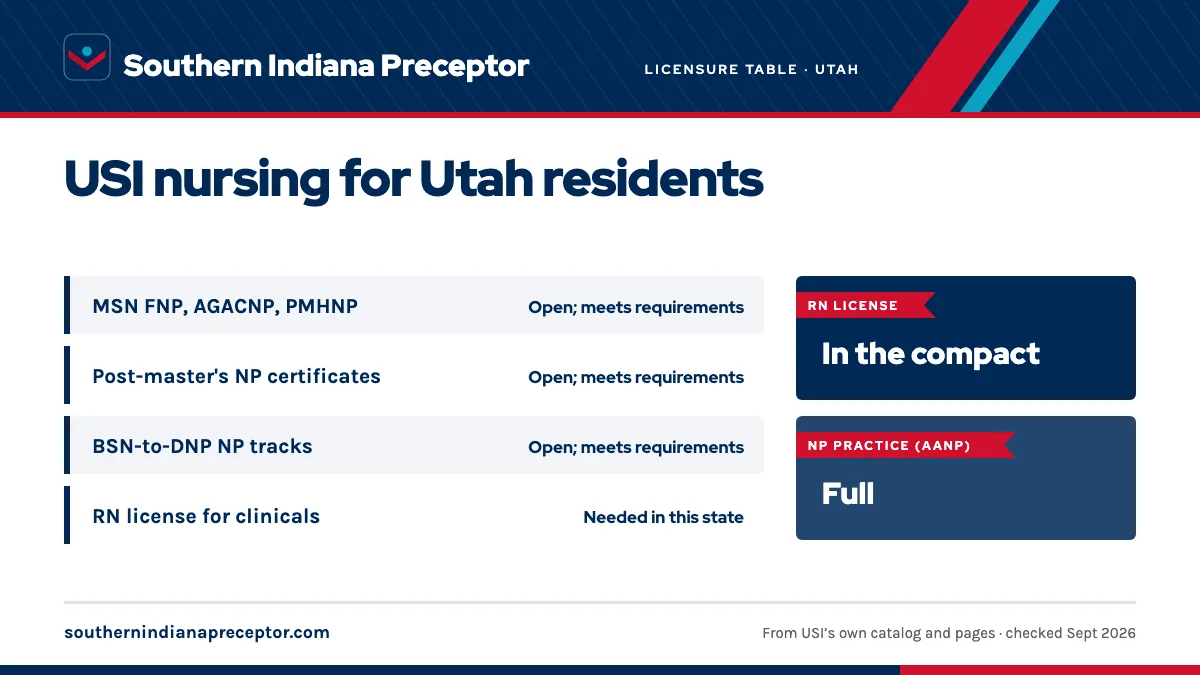
Utah on USI's disclosure
USI's Professional Licensure Disclosure, headed "Updated Fall 2025", places Utah in the "Meets Requirements" column for all nurse practitioner programs and keeps it off every Enrollment Not Allowed list. Of the five states that have enacted the APRN Compact, Utah is the one where residents can join every USI nursing program; Delaware and Wyoming are closed to the NP tracks, North Dakota to the MSN NP tracks and certificates, South Dakota to the certificates and BSN-to-DNP APRN tracks.
| Program | Licensure answer for Utah | Can Utah residents enroll? |
|---|---|---|
| MSN FNP, AGACNP, PMHNP | Meets requirements | Yes |
| Post-master's FNP, AGACNP, PMHNP | Meets requirements | Yes |
| BSN-to-DNP APRN tracks, post-MSN DNP | Meets requirements | Yes |
| Leadership MSNs, BSN-to-DNP OSL, RN-to-BSN | Does not lead to licensure | Yes |
Utah's rule for nursing programs based elsewhere
R156-31b-609, part of Utah's administrative code, is the gatekeeper for any school headquartered elsewhere that hopes to send students into a Utah clinic or hospital, and it treats a graduate NP program exactly as it treats a pre-licensure one. Before that happens, four things are checked by Utah's licensing division and its nursing board (formally the Board of Nursing and Certified Nurse Midwives):
- Standing: the school is approved at home by its own board and carries nursing accreditation from a federally recognized accreditor
- Faculty: employed by the program itself, qualified under accreditor and home-state measures, tied to a college or university, and licensed in Utah or a compact state for any face-to-face supervision
- Planning: a way to pick and supervise faculty or preceptors, along with their clinical sites
- Reporting: every August 1, a filing that counts the students sent to Utah facilities, swears that in-person faculty and preceptors hold proper licenses, and shows accreditation is still current
USI's graduate nursing programs hold CCNE accreditation (USI's accreditation); whether USI has made its case to Utah under this rule is not in our research. These steps belong to USI, not you, so ask the Nursing Clinical Coordinator whether Utah is cleared before you settle on a site.
Preceptors and places from Salt Lake City to St. George
Utah's preceptor test fits in one line: the preceptor's license, whether Utah's own or one from a compact member, must be in good standing. USI piles on specialty certification, twelve months or more as an advanced provider and its no-relatives rule (USI's preceptor rules). AANP places Utah among the full practice states.
Roughly 1.3 million people make up the Salt Lake City-Murray metro; Provo-Orem-Lehi and Ogden follow, and St. George, the southern outlier, has about 214,000. The state's major systems include Intermountain Health and University of Utah Health, and HCA operates MountainStar Healthcare. They describe where Utah NPs practice rather than name sites committed to USI students.
Two compacts, one still waiting
The RN compact has worked in Utah since its January 19, 2018 implementation, so a multistate RN license from Utah is honored across member states. The advanced practice version is another story. The governor signed Utah into it in March 2022; with only five states in, it stays dormant until a seventh joins. Until then, each NP license is good in one state only. Telehealth hours in FNP and PMHNP courses still require a license where the patient is (RN license guide).
Why Utah students bring us in
Utah's rule turns on licenses, so we check each preceptor's Utah or compact credential before anything reaches USI. We search near your home for preceptors who fit your USI course, fill in the Preceptor Packet line by line and name the site's agreement signer, and keep Fall, Spring and Summer lined up so the 750 hours stay on schedule. Start with your track.
Questions USI students ask
Does Utah have to clear USI before I start clinicals there?
Yes, the rule puts that burden on the school, and it exempts nobody for being a graduate program. Whether USI has already satisfied Utah is not in our research. Put the question to the Nursing Clinical Coordinator early so a pending state review never holds up your packet.
Can my Utah preceptor be licensed somewhere else?
For Utah, a compact member's license is as acceptable as Utah's own, provided it is in good standing. USI layers on its own conditions: an unencumbered license where the preceptor practices, certification in the specialty, and at least a year in advanced practice. Check both with the Nursing Clinical Coordinator before the Preceptor Packet goes in.
After graduating, could Utah's APRN Compact membership widen where I practice?
Only once the compact comes alive, and that needs seven enacting states; so far Utah has four partners (Wyoming, the two Dakotas and Delaware). Until a seventh signs, budget for a separate APRN license in every state where you plan to work.
Do Utah health systems accept USI students?
Our research records no Utah system's student placement process, so ask the system directly. USI's needs stay the same everywhere: a qualified preceptor, the site's signature on USI's Clinical Education Agreement, and approval from the Graduate Clinical Liaison before your first hour. USI's clinical deadlines set the timing.
Related pages
Last checked 2026-09-25
We check these pages against USI's own bulletin, program pages and Graduate Nursing Handbook. Your handbook, course faculty and the Nursing Clinical Coordinator have the final word.
USI makes the search your job. We make it the easy part.
Tell us your USI track, your city and your next clinical semester. We find preceptors who fit the NRSG course and fill the Preceptor Packet and Clinical Education Agreement request with typed, complete details, well before USI's 6-week window.
- Preceptors matched to the course: family primary care for FNP, acute care teams for AGACNP, PMHNPs and psychiatrists for PMHNP
- Preceptor license, certification, years of practice and the site's agreement signer ready for the packet
- Fall, Spring and Summer planned together, close to home in a state USI enrolls
Start your placement plan
Track, city and clinical start is all we need to begin.